Activity 6 - The Impact of Climate Change
This activity links to Global Goal 4.
In this activity, we learned about climate change and how it is impacting the world.
Using a range of sources, we conducted research investigate how Grimsby will be impacted as a result of climate change.
Our thoughts
Tyler W - Climate change poses significant risks to Grimsby and Humberside, including increased heat, sea level rise, and intensified extreme weather events like flooding and storms. These changes can impact various aspects of life, from health and infrastructure to the economy and the environment.
Tyler D - The rising waters pose a direct threat, with the potential to flood the Humber Bridge and Grimsby itself.
Suzie - By 2050, it is estimated that flooding will become more common, 22 ambulance stations, 90 police stations, 51 fire stations. 509 schools, 161 nurseries, and 63 college/ university buildings, 33 hospitals, 79 railway stations and 11 bus stations will be affected by this. And with this happening peoples wellbeing will be affected by this because they wont be able to go to school to make friends if they are being flooded .
Elena - The temperature has already risen by 1.8°C from 1979 to 2024 this increases the chances of sea levels rising. When combined with existing flood defenses, are projected to increase the frequency and severity of tidal flooding in the Humber estuary and surrounding areas, including Grimsby and Cleethorpes.
We then researched how climate change would impacted the area surrounding our partner school in Nigeria.
Our thoughts
Christian T - People are dying or being injured because of floods in Nigeria drowning people and extreme weather events .
Elena - In Nigeria, temperatures are rising due to climate change, with serious increases of temperature observed since the 1980s.People are worried that temperatures will increase even more from the decades. Sadly Nigeria is gearing up for more frequent and intense heat waves, with temperatures going over 40°C in many and even reaching record highs.This will affect people's health and not make much work since nobody will like to work in the extreme weather.
Corina - Nigeria has had many problems, some of them being floods. Nigeria is known to have the worst floods. Some floods have made over two million people lose their houses.Climate change is significantly impacting food security in Nigeria for example Nigeria is facing a severe food crisis, with millions experiencing hunger and malnutrition.
Libby - Climate change should be an even bigger problem there because Nigeria is on or near the equator and the closer you are the more hotter your country’s climate will be so their climate would probably be something like 40 something degrees? In 2014 the rainforests apparently flooded which probably affected most (or some) wildlife animals and that takes risk to animal extinction considering there was and still is no vet or animal hospitation an animal could receive in rainforests.
Use the links below to view our research about climate change.

|
1 - Climate Change | [pdf 56KB] |

|
|
|
2 -Climate Change | [pdf 99KB] |
|
|
|
3 - Climate Change | [pdf 59KB] |
|
|
|
4 - Climate Change | [pdf 158KB] |
|
|
|
5- Climate Change | [pdf 198KB] |
|
|
|
6 - Climate Change | [pdf 244KB] |
|
|
|
7- Climate Change | [pdf 64KB] |
|
|
|
8 - Climate Change | [pdf 24KB] |
|
|
|
9 - Climate Change | [pdf 2MB] |
|
|
|
10 - Climate Change | [pdf 41KB] |
|
|
|
11 - Climate Change | [pdf 62KB] |
|
|
|
12 - Climate Change | [pdf 37KB] |
|
|
|
13 - Climate Change | [pdf 28KB] |
|
|
|
14 - Climate Change | [pdf 44KB] |
|
|
|
15 - Climate Change | [pdf 25KB] |
|
|
|
16 - Climate Change | [pdf 23KB] |
|
|
|
17 - Climate Change | [pdf 185KB] |
|
|
|
18 - Climate Change | [pdf 57KB] |
|
We shared our research with our partner class in Nigeria. We are looking forward to hearing back from them soon.
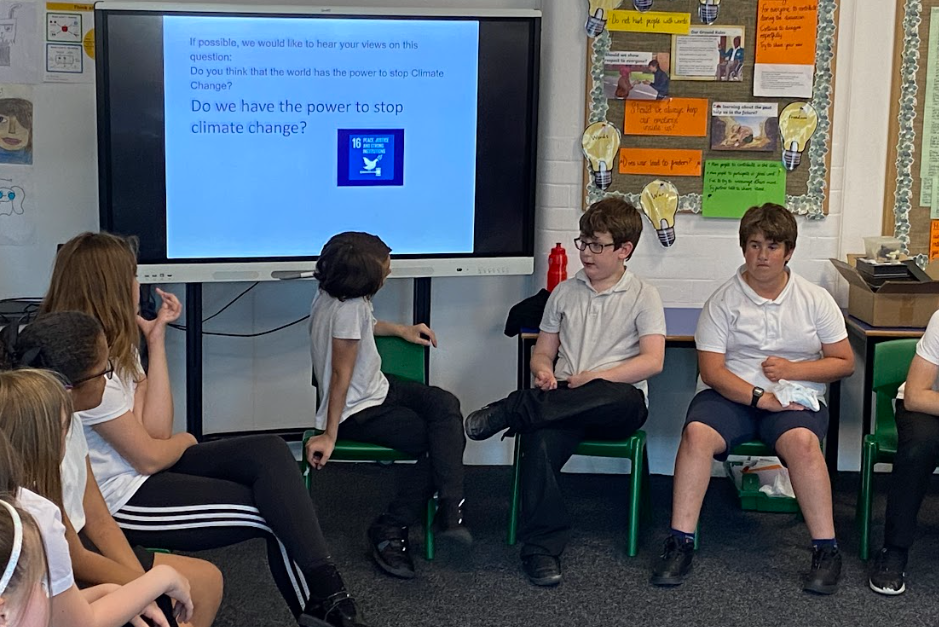
In the meantime, we used our P4C time to discuss the question.
"Do we have the power to stop climate change?"
These were the main points of our discussion.
- If the power is out we can use wind, sun and water power.
- Anything can help a bit and little can do big.
- If people listen to each other we can do something to stop global warmings and climate change.
- Wind, sun and water power can’t always be used in everything.
- Some rivers are drying up really quickly because of climate change.
- Fossil fuels will run out that will gradually stop greenhouse effect.
- What we have now, we will have it forever.
- Power is not only technology but natural resources as well.
- The Paris Agreement involves lots of countries and they came together to help lots of countries.
- Everyone should take responsibility but nobody is.
- Everyone can do something about it if we work together.
- Nothing can help because it is too complicated to solve.
- I'm going to do something even if it is little.
- We could swap cars because electric cars are better (Can't afford and not able to help but if they are good then the government might be able to drop prices if they are good ).
- Floods can affect their learning and it is getting worse and it is getting worse because nobody knows what to do.
Our Final Thoughts
Libby - I learnt that because Nigeria is so close to the equator, their climate is a lot hotter and their are more natural disasters, especially homes that are destroyed by flooding. Climate Change, sea-levels rising is causing even more flooding and even more homes are being destroyed. I felt intrigued when learning about this, because I did not realise that Climate Change was making things worse, not in other countries, so it was interesting to learn that Climate Change is making things worse for people in other countries.
Elena - I felt quite happy to learn about another country, how the declining weather is impacting them too, not just us, and looking at what is the same and different. In both places, they have experienced bad floods, in Nigeria they are getting worse, and they are in Grimsby too.Learning about different countries and that they are both experiencing the same problems in terms of Climate Change, such as flooding, makes me feel inspired that maybe we could work together in order to solve Climate Change, and made me realise that it is not an isolated problem, that all round the world, people are suffering because of the increased problems that Climate Change brings.
Jake - We looked at what our area would look like in 2050, Grimsby is meant to be completely flooded and Nigeria has a lot of flooding too and people's homes were broken and people were hurt. One example, a roof fell down and hurt someone.
Climate Change is getting worse, and the impacts are getting worse for both places.

Staff comments
This project offered a truly valuable opportunity for the children to delve into the impacts of climate change, exploring both current and predicted effects in Nigeria and comparing them directly to the situation in Grimsby. It was a rich experience for them to contrast their own daily lives and environmental challenges with those faced by children in Nigeria.
The students really shone when they applied their understanding of climate change to a new context, gaining a level of detail about Nigeria that they wouldn't typically encounter. It was particularly inspiring to hear the children share their own personal experiences during class discussions, including insights from those who have lived in Nigeria or travelled to other countries. These discussions naturally touched upon many aspects of the Global Goals, broadening their understanding of interconnected world issues.
A key revelation from their research was the discovery that both Nigeria and Grimsby are confronting similar climate change challenges, primarily flooding. However, the children were notably surprised to learn that the impacts of flooding are currently more severe in Nigeria than they are in Grimsby. This comparison offered a tangible and powerful lesson on the varied global realities of climate change.
Mr Birkett